
Hello, Salwa Besties! In contrast to beauty trends that involve a complex layering of numerous products, Japanese beauty, or J-Beauty, champions a minimalist, disciplined, and gentle approach. The ultimate goal is to achieve a “mochi skin” texture—meaning skin that is supple, firm, smooth, well-hydrated, and free from excessive oiliness.
The cornerstone of J-Beauty lies in patiently nurturing the skin barrier without the forceful application of aggressive chemicals. Let’s delve into the four essential steps of the Japanese skincare ritual!
4 Essential Steps of Traditional Japanese Facial Care
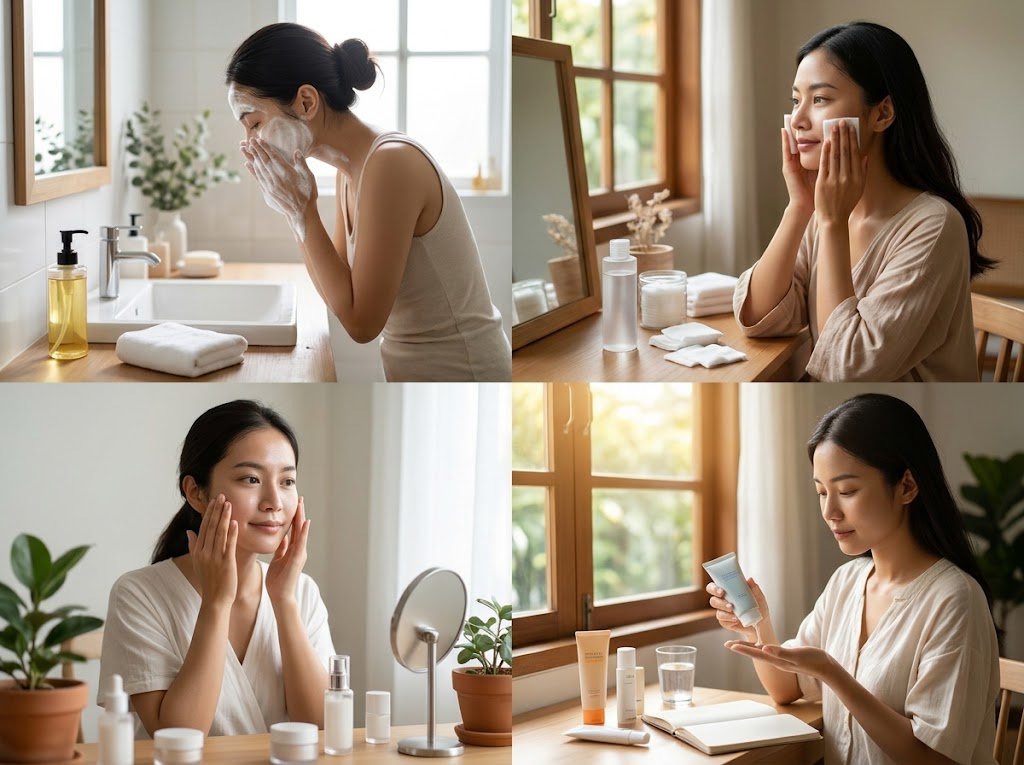
1. Gentle Double Cleansing (Cleansing Oil & Micro-Foam)
Begin your cleansing ritual with a rice-based or camellia oil cleanser to effectively dissolve makeup and sunscreen. Follow this with a facial cleanser that creates a dense micro-foam, ensuring your fingertips glide gently over the skin without harsh friction during rinsing.
2. Double Moisture with Hydrating Lotion (Kesho-sui)
In Japan, toners are often referred to as highly hydrating lotions. This liquid is gently patted onto the face or applied using a cotton pad compress technique (lotion pack) for 3 minutes to lock in hydration down to the dermal layers.
3. Sealing Moisture with a Lightweight Emulsion (Nyueki)
Instead of immediately reaching for heavy, pore-clogging creams, Japanese women opt for lightweight, water-based emulsions with a balanced ratio of botanical oils to seal in moisture without overwhelming the pores.
4. Daily Broad-Spectrum Sunscreen Protection
Japan is a pioneer in developing comfortable, watery essence sunscreen formulas. Applying water-resistant and sweat-proof sunscreen is an absolute non-negotiable before stepping outdoors to combat premature aging.
The Efficacy of the Lotion Pack Technique in Strengthening the Skin Barrier:
“The most frequently overlooked principle of J-Beauty is the absolute prohibition of aggressively rubbing the facial skin with thick cotton pads. In the salon, we consistently educate clients on the signature Japanese lotion pack technique: saturate several thin, lint-free cotton pads with a hydrating lotion rich in fermented rice (sake kasu) or hyaluronic acid, then gently press them evenly onto the forehead, cheeks, and chin for 3 minutes, akin to mini sheet masks. This cooling compress method reduces surface skin temperature inflamed by tropical sun exposure while simultaneously maximizing water molecule absorption into the stratum corneum without inducing mechanical friction that triggers premature aging.” — Fatmawati Tahir
The Principle of Gentleness Without Harsh Friction
Throughout every step of your routine, avoid pulling or rubbing your skin. Employ gentle patting motions with your warm palms to naturally stimulate facial blood circulation.
Japanese Skincare FAQs
What is the fundamental difference between K-Beauty and J-Beauty?
K-Beauty focuses on achieving an instant dewy glow (glass skin) through multi-step product application, whereas J-Beauty emphasizes formula simplicity, deep hydration, and a matte, supple skin texture (mochi skin).
What are the most common natural ingredients used in Japanese skincare?
Fermented rice (sake kasu), Ukiyo green tea extract, seaweed, and camellia flower oil are the primary botanical ingredients inherited from Japanese ancestral traditions.
Is the lotion pack technique safe for daily use?
It is exceptionally safe, provided the cotton pads are saturated with a hydrating lotion free from alcohol and synthetic fragrances.




Tinggalkan Balasan