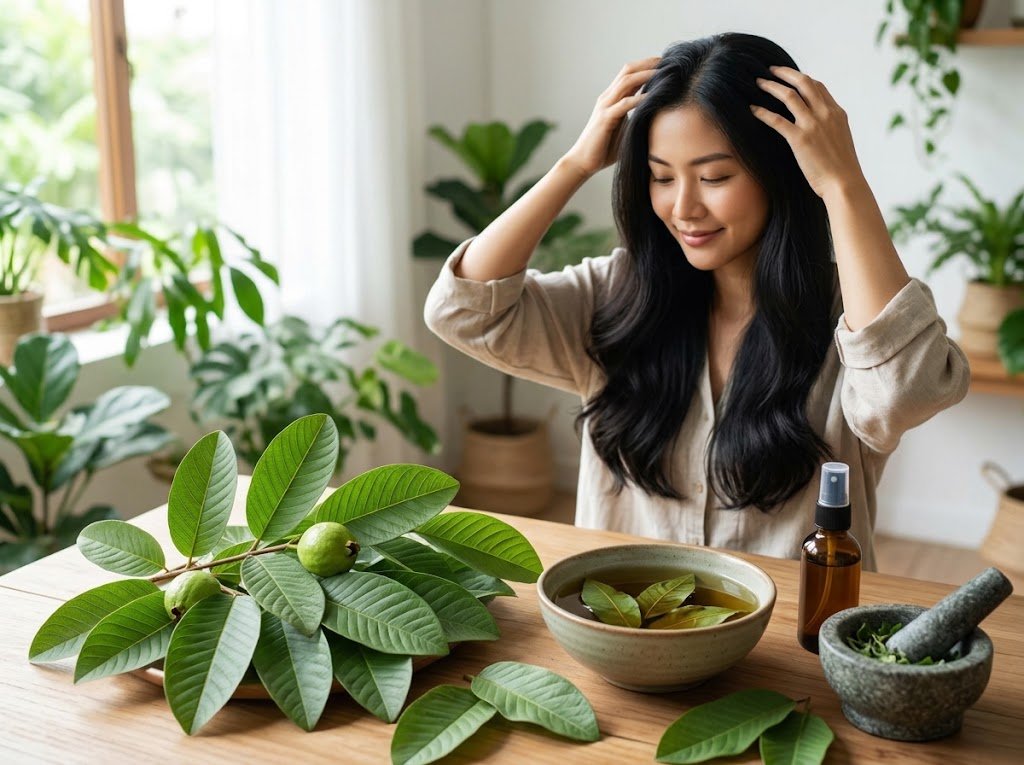
For a long time, we may have only known guava leaves as a traditional herbal remedy for stomachaches or diarrhea. But did you know? In the realm of natural hair care, guava leaf tips hold remarkable efficacy, long serving as a secret staple for halting severe hair loss and eradicating stubborn dandruff!
- 1 Nutritional Profile of Guava Leaves Beneficial for Hair
- 2 3 Tangible Benefits for Your Hair’s Health
- 3 How to Make Your Own Guava Leaf Decoction Hair Tonic
- 4 Salon Formulation & Application Tips
- 5 Q&A About Guava Leaf Hair Treatments
- 6 How often should guava leaf decoction be used per week?
- 7 How long can guava leaf decoction be stored?
- 8 Can guava leaf water alter the color of bleached or dyed hair?
- 9 Returning to Natural Goodness
Instead of resorting to harsh chemical-laden products that can strip the scalp’s protective barrier, guava leaf decoction offers gentle, eco-friendly botanical nutrients that you can easily prepare at home for a fraction of the cost. Let’s delve into its nutritional profile and practical applications for your crowning glory!
Nutritional Profile of Guava Leaves Beneficial for Hair
Research in herbal cosmetics confirms that guava leaves are rich in essential bioactive compounds, including:
- Quercetin and Flavonoids: Potent antioxidant compounds possessing natural antifungal and antibacterial properties. These agents work to inhibit the proliferation of Malassezia fungus—the primary culprit behind dandruff and scalp itchiness.
- High-Dose Vitamin C: Stimulates collagen production and strengthens hair follicle structures, preventing hair strands from easily fracturing during brushing.
- Natural Anti-Inflammatory Properties: Soothes scalp inflammation, redness, irritation, and itching caused by harsh sun exposure and pollution.
- Lycopene: A pigment antioxidant that helps protect hair fibers from degradation due to ultraviolet (UV) radiation.
3 Tangible Benefits for Your Hair’s Health
- Eliminates Dandruff and Soothes the Scalp: The antimicrobial activity of flavonoids gradually clears dandruff flakes without leaving the scalp feeling parched and dry.
- Reduces Hair Loss and Strengthens Roots: Its nutrient content penetrates the dermal papilla of the follicles, anchoring hair strands more robustly from the root.
- Stimulates New Hair Growth: Massaging with guava leaf decoction aids in microcirculation on the scalp, promoting the growth of denser, thicker new hair strands.
How to Make Your Own Guava Leaf Decoction Hair Tonic
- Gather a handful of fresh guava leaves (approximately 10–15 leaves), and rinse them thoroughly under running water to remove dust and debris.
- Boil the leaves with 1 liter of clean water in a pot until it reaches a rolling boil.
- Reduce the heat to low and let it simmer gently for 15 to 20 minutes until the water turns a deep, brownish-yellow hue.
- Turn off the heat, strain out the leaves, and allow the decoction to cool to room temperature.
- Pour the liquid into a clean spray bottle. Your herbal tonic is ready for use!
Salon Formulation & Application Tips
While guava leaf decoction is rich in antifungal flavonoids, the key lies in fundamental scalp cleanliness prior to application. Never spray any herbal tonic onto a scalp laden with heavy oil or residual styling products, as nutrients will not penetrate the follicles. Begin by shampooing with a gentle clarifying shampoo, towel-dry to about 50% moisture, then spritz the guava leaf tonic while performing a 5-minute circular massage to open the dermal papilla absorption pathways.
Q&A About Guava Leaf Hair Treatments
How often should guava leaf decoction be used per week?
For optimal results, use it 2 to 3 times per week consistently. Within 3–4 weeks of regular use, dandruff-related itching typically subsides, and hair loss is significantly reduced.
How long can guava leaf decoction be stored?
Store in a sealed bottle in the refrigerator. This decoction can remain fresh and effective for 4 to 7 days. If the aroma turns sour or a cloudy sediment appears, prepare a fresh batch.
Can guava leaf water alter the color of bleached or dyed hair?
Due to its mild natural brownish pigment, for individuals with very light blonde hair (high-level bleaching), it is advisable to perform a strand test first to avoid imparting a warm hue.
Returning to Natural Goodness
Sometimes, the best solutions for our hair concerns are readily available in nature, without requiring significant expense. Dedicate a little time on the weekend to prepare this guava leaf decoction, and experience the return of your scalp’s natural vitality!




Tinggalkan Balasan