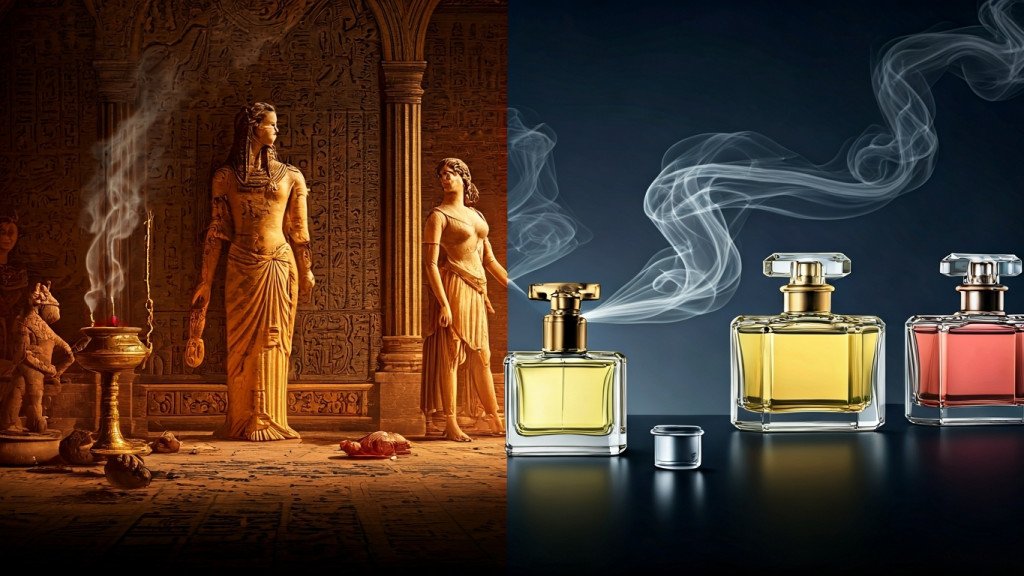
Spritzing a fragrance on your wrists before stepping out the door often serves as a final ritual, bestowing an instant sense of confidence. The scent that lingers on your clothing not only accompanies your daily movements but also leaves a powerful imprint of memory on those around you. However, few realize that behind the elegance of a perfume bottle lies a history of human civilization spanning thousands of years.
The history of global perfumery is rooted in the ancient Egyptian ritual of burning resin as a spiritual medium, evolving into a symbol of luxury in European Renaissance courts, and transforming into a modern industry focused on environmental sustainability and boundless self-expression. This evolution proves that scent has long been a mirror of human technological advancement and cultural order.
Scent as a Spiritual Bridge in Ancient Civilizations
The word “perfume” originates from the Latin phrase per fumum, meaning “through smoke,” referring to the tradition of burning aromatic materials to release fragrant plumes into the air. Ancient Egyptians utilized a blend of kiphy incense, composed of myrrh resin, frankincense, and wild honey, in every sacred temple worship ceremony.
Beyond religious ritual, aromatic oils were used to maintain the suppleness of noble skin against the harsh desert sun. In Mesopotamia, the oldest historical records on clay tablets name Tapputi as the first perfumer, who utilized a simple distillation process from flowers and fragrant resins.
Extraction techniques saw a significant leap during the golden age of Islamic civilization when physician Ibn Sina introduced steam distillation using a cooling coil apparatus. This innovation enabled the extraction of essential rose oil, yielding a clear aromatic water with far greater stability than traditional oil infusions.
| Historical Period | Dominant Raw Materials | Primary Manufacturing Technique | Social and Cultural Function |
|---|---|---|---|
| Ancient Egypt (3000 BCE) | Myrrh resin, frankincense, cinnamon oil | Hot maceration with animal fats and vegetable oils | Rituals of divine offerings and noble embalming. |
| Classical Islam (10th Century) | Rose petals, cardamom spice, ambergris | Multi-stage steam distillation with pure alcohol | Physiotherapy, sanitation, and personal fragrance. |
| European Renaissance (16th Century) | Grasse jasmine, lavender, bergamot peel | Cold fat extraction (enfleurage) and distilled alcohol | Status symbol for court nobility and masking urban odors. |
| Contemporary Modern | Molecular isolates, ethical synthetic aromas | Carbon chemical fractionation and organic material recycling | Self-identity expression and sustainable fragrance artistry. |
The Shift of Scent to a Symbol of European Noble Luxury
Entering the sixteenth century, global spice trade brought the art of perfumery to Italy and France. Prominent figures like Catherine de’ Medici popularized the use of leather gloves soaked in fragrant scents to mask the pungent odor of tanning.
The town of Grasse in southern France gradually developed into a center for cultivating the finest jasmine, tuberose, and rose plantations in Europe. Fragrance was no longer merely an emergency hygiene tool but a marker of social standing and aesthetic taste for the powerful monarchies.
Possessing a custom-blended fragrance became an exclusive privilege that distinguished the elite from the common populace. Each gold-adorned glass bottle held a secret formula strictly passed down through generations of royal perfumers.
The Golden Age of Synthetic Chemistry and Sustainability Responsibility
The industrial revolution at the end of the nineteenth century ushered in a new era with the discovery of synthetic molecules like vanillin and coumarin. These discoveries enabled fragrances to be mass-produced at more affordable prices without the need to harvest thousands of tons of rare flowers from the wild.
Today, the global industry’s attention is focused on the transparency of raw material supply chains and the utilization of recycled wood and flower waste-based aromas. Modern consumers demand formulas that do not harm forest ecosystems and are free from animal cruelty testing.
Salwa Salon Editorial Note: Indonesia’s warm and high-humidity tropical air accelerates the evaporation of fragrance particles on the skin. Opt for Eau de Parfum concentrations with a base of sandalwood or local vetiver root, which can bind the scent more stably throughout the day without being overpowering to the olfactory senses.
To perfect your daily appearance with a scent that reflects your natural character, you can refer to our in-depth guide on tips for choosing fragrances according to daily activities.
Frequently Asked Questions (FAQ)
Did ancient perfumes have a liquid form like they do today?
No, ancient fragrances were typically in the form of thick salves made from vegetable fats or solid resins burned over embers.
Why does perfume smell different when applied to different people’s skin?
The chemical reaction between aromatic oils and each individual’s skin acidity, body temperature, and unique sebum levels influences the evaporation of fragrance particles.
What is the average longevity of an Eau de Parfum scent in a tropical climate?
Eau de Parfum concentrations generally last between five to eight hours on well-hydrated skin before the scent naturally fades.
Are synthetic fragrance ingredients harmful to skin health?
Modern synthetic ingredients have undergone rigorous dermatological safety standardization, making them safe for use and, in fact, preventing the overexploitation of rare flora.


Tinggalkan Balasan