
Have you ever tried to follow a viral makeup trend or haircut style, only to look in the mirror and feel like it just doesn’t quite harmonize with your facial features? This often happens when we focus solely on mimicking a specific facial element—like a particular lip shape or eyebrow arch—without considering the overall proportional balance of the face. In the realm of modern beauty and aesthetics, the prevailing approach increasingly emphasizes the principles of facial anatomical harmony.
Facial harmony and the golden ratio represent a science-based aesthetic approach that assesses visual appeal through the proportional balance of the forehead, eyes, nose, lips, and jawline structure in three dimensions (3D). Rather than aiming for uniformity in everyone’s facial shape, this concept focuses on accentuating the unique anatomical congruity of each individual to achieve a natural look from both frontal and profile views.
Understanding the Anatomical Foundation Behind Facial Appearance
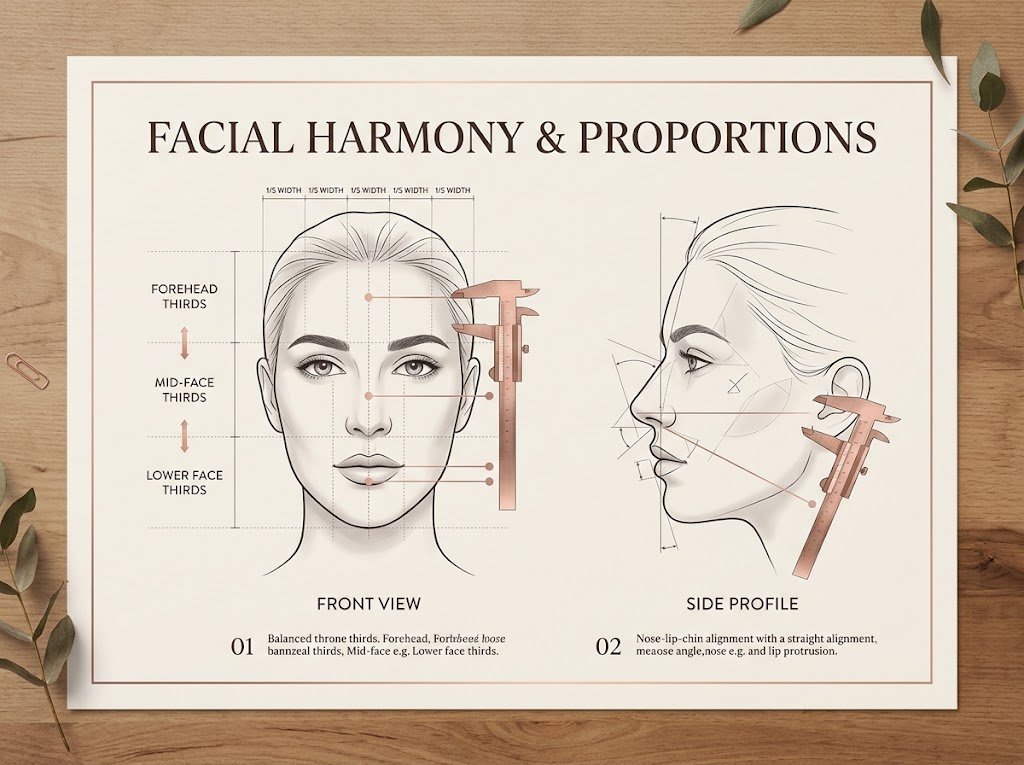
For years, beauty treatments have often been perceived as merely superficial skin polishing. However, a person’s facial contour is shaped by a layered interplay between epidermal quality, dermal connective tissues, subcutaneous fat pads, expression muscles, and the underlying skeletal support structure.
As explained by aesthetic practitioner Dr. Dewita Kamaruddin, achieving a proportional appearance requires an understanding of this foundational facial tissue architecture. When skin health and the integrity of its supporting structures are well-maintained, facial lines appear more defined and refreshed without a stiff or unnatural look.
The Principle of the Golden Ratio and Facial Proportion Division
In the study of aesthetics and fine arts, the golden ratio (an approximate mathematical ratio of $1 : 1.618$) is frequently used as a benchmark for measuring visual proportions that are pleasing to the human eye. When applied to the face, beauty experts and stylists typically observe three vertical divisions (facial thirds):
- Upper Third: The distance from the hairline to the glabella (the midpoint between the eyebrows).
- Middle Third: The distance from the glabella to the subnasale (the base of the columella of the nose).
- Lower Third: The distance from the subnasale to the menton (the lowest point of the chin).
This understanding of proportion applies equally to both men and women. The primary objective is not to rigidly conform to mathematical figures, but rather to help us identify areas that may benefit from added volume or subtle camouflage to create a balanced facial composition.
The Shift Towards Three-Dimensional (3D) Facial Harmony
One of the most compelling developments in current global beauty trends is the three-dimensional (3D) facial evaluation. The human face is not static like a two-dimensional photograph; we speak, smile, and are viewed from various angles.
In facial harmony analysis, facial proportions are not only observed from the front—such as intercanthal distance or lip width—but also from a profile view. The imaginary line connecting the tip of the nose, lips, and chin, along with the definition of the jaw angle, significantly determines whether a facial profile appears balanced or appears to droop.
Expert Note — Fatmawati Tahir:
“The principle of facial harmony can actually be effectively applied non-invasively through salon styling. For instance, if your upper facial third (forehead) is quite broad, adding curtain bangs can instantly balance facial ratios. Similarly, styling the arch of the eyebrows and strategically placing hair layers around the chin can create the illusion of a more proportional jawline without medical procedures.”
The Relevance of Facial Harmony Across Age Phases
This approach to facial proportional balance is relevant across various age groups, from young adults to mature individuals (30s and beyond). In late adolescence and the 20s, the focus typically lies on selecting eyebrow shapes, makeup contouring techniques, and haircuts that complement inherent facial bone structure.
As we age, natural aging processes lead to changes in skin elasticity, reduction in fat pads, and shifts in facial muscles. This often results in a less defined jawline from the side or the appearance of submental fullness (double chin). Skin-tightening treatments, facial massage for lymphatic drainage, and judiciously applied aesthetic procedures can help maintain these harmonious proportions.
Frequently Asked Questions (FAQ)
Does a face need to be perfectly symmetrical to be considered attractive?
No. Nearly all individuals possess a degree of natural asymmetry between their left and right facial sides. The concept of facial harmony does not pursue absolute, artificial-looking symmetry but rather aims to maintain overall proportional balance both at rest and in expression.
How can I determine my own facial thirds proportions at home?
You can take a straight-on frontal photo of your face with your hair pulled back. Then, measure the vertical distances from your hairline to your eyebrows, from your eyebrows to the base of your nose, and from the base of your nose to your chin. The most dominant measurement can be balanced through hairstyle choices or makeup techniques.
How can a haircut help balance the jawline profile?
If you have a tendency towards a shorter chin or a rounded jawline, an asymmetrical textured long bob or layers that fall just below the collarbone can help direct the eye vertically, making the neck and jawline appear more elongated.
Understanding your own facial structure and proportions empowers you to make far more informed and judicious treatment decisions. If you wish to discuss haircut styles, fringe framing, or eyebrow shaping that best harmonizes with your facial anatomy, we warmly welcome you at Salwa Salon.



Tinggalkan Balasan